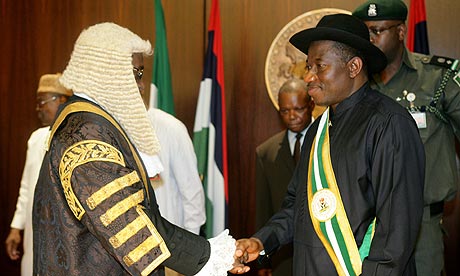
According to an article by BBC News on May 7th, numerous Nigerian groups are lobbying for the vice-presidency of the recently sworn in Goodluck Jonathan. Analysts predict that the individual chosen for the position will likely be a strong contender in the 2011 election-- a prediction that adds significant weight to Jonathan's decision.
Jonathan will almost definitively pick an individual in the northern region of Nigeria, an action designed to pacify the severity of the countries cleavages. The presidency in Nigeria has alternated between the predominately Christian south and the Muslim north, and Yar'Adua's death signified a shortened period of Muslim rule. As a Christian, Jonathan must maintain regional balance to have a chance of having a less volatile period of rule.
Several names have been suggested thus far, including former anti-corruption chief Nuhu Ribadu and Yar'Adua's nephew, Murtala Yar'Adua. However, there has been speculation that Jonathan will defy political convention and stand as a candidate for the 2011 presidency in the governing People's Democratic Party.
Jonathan's delicate task of choosing a vice-president reveals the deep cleavages which have ravaged Nigeria. He is all but required to pick a northern Muslim to counterbalance his Christian presidency. The legitimacy of his presidency will likely be substantially hurt if he chooses to ignore this political tradition. By being sworn into the highest political office, Jonathan also took part in an important political change that thus far has not provoked the brutal protests of past presidencies. If he decides to represent the PDP personally in the upcoming 2011 election, Jonathan will break a political convention and alter the political institutions for future generations.
Photo Source: Click Here
Grade This Post
Jonathan will almost definitively pick an individual in the northern region of Nigeria, an action designed to pacify the severity of the countries cleavages. The presidency in Nigeria has alternated between the predominately Christian south and the Muslim north, and Yar'Adua's death signified a shortened period of Muslim rule. As a Christian, Jonathan must maintain regional balance to have a chance of having a less volatile period of rule.
Several names have been suggested thus far, including former anti-corruption chief Nuhu Ribadu and Yar'Adua's nephew, Murtala Yar'Adua. However, there has been speculation that Jonathan will defy political convention and stand as a candidate for the 2011 presidency in the governing People's Democratic Party.
Jonathan's delicate task of choosing a vice-president reveals the deep cleavages which have ravaged Nigeria. He is all but required to pick a northern Muslim to counterbalance his Christian presidency. The legitimacy of his presidency will likely be substantially hurt if he chooses to ignore this political tradition. By being sworn into the highest political office, Jonathan also took part in an important political change that thus far has not provoked the brutal protests of past presidencies. If he decides to represent the PDP personally in the upcoming 2011 election, Jonathan will break a political convention and alter the political institutions for future generations.
Photo Source: Click Here
Grade This Post


 Posts
Posts


